Saturday, 1 July 2017

Neo- Classical Theory ( Evolution of Management )


George Elton Mayo
George Elton Mayo, social theorist and industrial psychologist, was born on December 26, 1880 in Adelaide, Australia. In 1897 entered the University of Adelaide and finally to the University of Edinburgh where it tried three times to study medicine, discovered that it was not really his thing; So in 1907 he returned to the University of Adelaide where he studied philosophy and psychology. He graduated with was appointed professor in mental and moral philosophy at the University of Queensland. On April 18, 1913 in Brisbane he had married Dorothea McConnel.

The Harvard School appointed him associate professor in 1926 and professor of industrial research in 1929. There he joined research and designed on the personal and social factors that determine the production of work at the Western Electric Co.'s Chicago plant, These famous Hawthorne experiments were pioneering studies in modern social research. May was one of the most influential, though controversial, social scientists of his time.

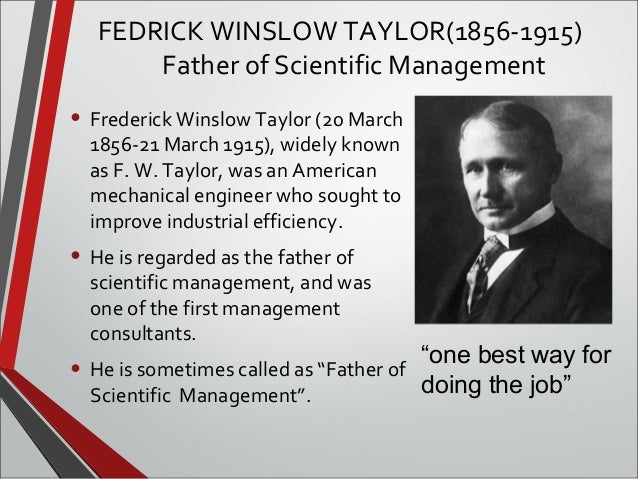
Scientific Management by F.W. Taylor ( BIOGRAPHY )

                                                                     Biography

* Taylor was born in 1856 to a wealthy Quaker family in Germantown, Philadelphia, Pennsylvania.

Educated early by his mother, Taylor studied for two years in France and Germany and traveled Europe for 18 months. In 1872, he entered Phillips Exeter Academy in Exeter, New Hampshire.

Upon graduation, Taylor was accepted at Harvard Law. However, due to rapidly deteriorating eyesight, Taylor had to consider an alternative career. After the depression of 1873, Taylor became an industrial apprentice patternmaker, gaining shop-floor experience at a pump-manufacturing company, Enterprise Hydraulic Works, in Philadelphia. Taylor's career progressed in 1878 when he became a machine shop laborer at Midvale Steel Works. At Midvale, Taylor was promoted to gang-boss, foreman, research director, and finally chief engineer of the works. Taylor became a student of Stevens Institute of Technology, studying via correspondence and obtaining a degree in mechanical engineering in 1883. On May 3, 1884, he married Louise M. Spooner of Philadelphia.

Fayol’s fourteen Principles of management

 Administrative Management - Contribution of Henri Fayol

Henri Fayol was real father of modern Management. Henri Fayol is the French industrialist in 1841-1925. He was a mining engineer in.  Henri Fayol spent his entire working career in French industry; French cool and iron combine of commentary fourchambault. Henri Fayol developed a general theory of Business Administration.

Henri Fayol was concerned the principles of organization and the function of management. Fayol laid the foundation of management as a separate body of knowledge. He always insisted that if scientific forecasting and proper methods are used in management than company can get satisfactory results.  According to Fayol, management was not personal talent; it is a knowledge base skill.


INTRODUCTION TO EMPLOYEE ENGAGEMENT AND DEFINITIONS

Human resource executives in India continue to struggle with talent management issues, particularly retention. the quest to find the best way to retain employees has taken HR pundits through concepts such as employee review,  latest idea is "employee engagement " , a concept that, it is the degree to which employee is emotionally bonded to his organization and passionate about his work that really matters .

Employee engagement is an emergent property of relationship between an organization and its employees. An "engaged employee " is one who is fully absorbed by and enthusiastic about their work and so takes positive action to further the organization 's reputation and interests.

* According to David Macleod "This is about how we create the conditions in which employees offer more of their capability and potential ".

*According to Khan "The harnessing of organization members" their work roles; in engagement, people employ and express themselves physically , cognitively , and emotionally during role performance".

In the article Psychological conditions of personal engagement and disengagement at work (1990) Khan describes employee engagement as the combination of three conditions: psychological meaningfulness, psychological safety, and psychological availability. This article is the basis of the reflection on employee engagement. It is important to understand those principles in order to continue any discussion about employee engagement.


The psychological meaningfulness relates to employees’ need to feel valued about their work by others and by themselves. The creation of clear goals, with adequate level of challenge juxtaposed with creativity and autonomy help developed a feeling of meaningfulness.

The psychological safety relates to the relationship of the employee with his coworker and superiors. The employee has to feel supported by his coworker and superior in his everyday work. The dynamic of groups, the management style and the organizational norms have to be “predictable, consistent and nonthreatening” (Khan 1990).

The psychological availability relates to the availability of emotional and psychological energies to perform the work. Furthermore, the feeling of security and confidence “in own abilities and status, self-consciousness and ambivalence about fit with social system”. The outside life also can impact psychological availability. Employee with high psychological availability will not be distracted in their work.

Finally, engaged employee feel safe, available and have a sense of meaningfulness You may still wonder why you should care about Employee engagement? Here are some reasons:

    *  Engaged employees go for the extra mile when needed while non-engaged employees stop working as soon as their time is done.
    *  Engaged employees care about their organization and do their best to fulfill their requirements and sometimes surprise you.
    *  Engaged people are productive.

> It is important to note that employee engagement is a ideal state that is worth pursuing. All jobs and peoples are not made or design for engagement. The pursuit of an ideal allows to improve current conditions. In this sense Employee Engagement is a good concept. It forces to wonder and reflect on the impact of leadership, employee relationships and emotions on an organization productivity.

> Employee engagement can be measured, this will be the subject of a future post. Until then, have a good week.

Wednesday, 21 August 2013

OU-MBA(Day) 3rd Semester Syllabus

OU-MBA(Day) 3rd Semester Syllabus

3.1: Total Quality ManagementUnit-I: TQM- History and Evolution:
Connotations of Quality, Quality Dimensions – Product and Se rvice. The concept of TQM, Evolution of TQM – Inspection, SQC, QA and TQM. Conventional quality management versus TQM. Customer supplier focus in TQM. Benefits and Costs of TQM. Historical perspectives of TQM. Quality System Awards and Guidelines – ISO, Malcolm Baldrige Nationa l Quality Award (MBNQA), European Foundation for Quality Management (EFQM).
Unit – II: Tools of TQM:
Measurement Tools: Check Sheets, Histograms, Run Charts, Scatter Diagrams, Cause and Effect Diagrams, Pareto’s Chart, Process Capability Measurement. Analytical Tools: Process Mapping, Regression Analysis, Resource Utilization and Customer Se rvice Analysis, The Five Why’s, Overall Equipment Effectiveness. Improvement Tools and techniques: Kaizen, JIT, Quality Circles, Forced field Analysis, Five S’s. Control Tools: Gantt Chart, Network Diagram, Radar Chart, The PDCA cycle, Milestone Tracker Diagram and Earned Value Management.
Unit – III: Techniques of TQM:
Quantitative techniques: Failure Mode Effect Analysis (FMEA), Statistical Process Control (SPC), Quality Function Deployment (QFD), Design of Experiments (DOE), Quality by Design and Monte Carlo Technique (MCT). Qualitative techniques: Benchmarking, The Balanced Scorecard, Sales and Operations Planning, Kanban and Activity Based Costing (ABC). Taguchi methods: Quality loss function, Orthogonal arrays, Signal-to-Noise ratio: Nominal- the- best, Target-the-best, Smaller-the-best, Larger-the-best. Parameter design, Tolerance design.
Unit – IV: Six Sigma:
The concept of Six Sigma, Objectives of Six Sigma, The frame-work of Six Sigma programme, Six Sigma Organization: roles and responsibilities, Six Sigma problem solving approach: The DMAIC model, Six Sigma Metrics: Cost of poor quality, Defects per million opportunities and First pass yield. Benefits and costs of Six Sigma.
Unit –V: TQM in the Service Sectors:
Implementation of TQM in service organization: Framework for improving service quality, Model to measure service quality programs. TQM in Health-care services, Hotels and financial services –Banks, Investment Company and Mutual Funds.
Suggested Books:
1. John L. W. Beckford, “Quality: A Critical Introduction”, 3r d Ed. Routledge – Taylor and Frances Group, New York and London.
2. Dale H. Besterfield, Carol Besterfield - Michna, Glen H Besterfield and Mary Besterfield-sacre, “Total Quality Management”, 2006, 3r d Ed. PHI.
3. Ron Basu, “Implementing Quality: A Practical Guide to Tools and Techniques”, 2006, THOMPSON.
4. Greg Brue, “Six Sigma for Managers”, 2002, TMH.
5. R. P. Mohanty & R. R. Lakhe, “TQM in the Service Sector”, Jaico Books.
6. Kanishka Bedi, “Quality Management”, Oxford University Press.
7. Howard S Gitlow, Alan J Oppenheim, Rosa Oppenheim and David M Levine, “Quality Management”, Tata McGraw-Hill, 3r d Ed.
8. Sunil Sharma, “Total Engineering Quality Management”, 2003, Macmillan India Ltd.
9. Poornima M Charantimath, “Total Quality Management”, 2003, Pearson.
10. Mukherjee, P N, “Total Quality Management”, 2007, PHI.
11. “The Six Sigma Instructor Guide”, Green belt Training made easy, 2008, 2n d Ed. Macmillan
12. Kanji K. Gopal & Asher Mike, “100 methods for TQM’, Response.

3.2: International BusinessUnit - I: Global Imperative:
An overview–International Business: A global perspective–Emergence of Globalization–Drivers of Globalization–Internationalization Process–Stages in International Business–Approaches to International Business; The World of International Business: Regional and Global Strategy–The Multina tional Enterprise–Triad and International Business–International Trade Theories; Environment of Internat ional Business-Cultural Environment and Political Environment.
Unit - II: Glob al Business & National Regulation:
Rationale for Government Intervention–Forms of Trade Regulation at National Level-Tariff and Non-Tariff Barriers. Regional Economic Integration: Levels of Economic Integration–Benefits & Costs of Economic Integration-Major Trading Blocks: EU, NAFTA, ASEAN and SAAR C. Multilateral Regulation of Trade and Investment-Basic Principles of Multilateral Trade Negotiations–GATT and its early Rounds–World Trade Organization–Structure and functions–TRIPs & TRIMs-WTO & India–UNCTAD.
Unit – III: Global Business and Entry Strategies:
Global Market Entry Strategies–Exporting, Licensing, Franchising, Contract Manufacturing,
Assembly and Integrated Local manufacturing. Global Ownership Strategies: Strategic Alliance–Types of Strategic Alliances–Selection of Strategic Alliance Partner, managing and sustaining Strategic Alliance–Cost and Benefit Analysis of Entry Strategies: Entry Analysis and Entry strategy configurati on.
Unit – IV: Global E-Business:
Conceptual Framework of E-business–Prerequisites for Effective E-business Transactions–E-enabled Business Process Transformation and Challenges–E-business Technology and Environment–E-Business Applications–E- Business Models–Alternative E-business Strategi es–Global E- Marketing –Electronic Processing of International Trade Documents – Policy Framework for Global E-business
Unit - V: Managing Global Busines s:
Strategy and Global Organization -Global Strategic Planning–Going Global and Implementing Strategies–Intercultural Communications–Intercultural Human Resources Management in Global Context.
Suggested Books:
1. Charles W.K Hill, and Arun K. K. Jain, “International Business, - Competing in the Global Market Place”, 2010, 6t h Ed. Tata McGraw Hill. S. Tamer Cavusgil, Gary Knight, JohnR. Riesenberger, 2010, Pearson Ed.
2. Michael R. Czinkota, LLkk. A. Ronkainen and Michael H. Moffett, “International Business”, 2009, 7th Ed, Cengage Learning, New Delhi.
3. Alain Verbeke, “International Business Strategies” 1st edition, 2009, Cambridge
4. Rakesh Mohanh Joshi, “International Business”, 2009, Oxford University Press.
5. David H. Holt and Karen W. Wigginton, “International Management”, 2007, Thomson.
6. Jeanett and Hennessey, “Global Marketing Strategies”, 2005, Jaico, New Delhi.
7. Subba Rao, 2007, “International Business”, 2010, Himalaya Publications, New Delhi.
8. Bholanath Dutta, “International Business Management”, 2010, Text & Cases, Excel, New Delhi.
9. John D. Daniels & Lee H. Radebaugh, “International Business”, 2006, Pearson Education.
10. Hodgetts, Luthans and Doh, “International Management Culture, Strategy and Behaviour”, 2006, Tata McGraw-Hills, New Delhi.
11. Anan t. K. Sundaram and J. Stewart Black, “The International Business Environment”, 2009, Test and Cases, PHI Learning, New Delhi.
12. Pradip Kumar Sinha and Sanchari Sinha, “International, Business Management”, 2008, Excel, New Delhi.
13. Mike W. Peng, “International Business”, 2008, Cengage Learning, New Delhi.
14. Aswathappa, K, “International Business”, 2010, Tata McGraw Hill, New Delhi.
15. Nag. “International Business Strategy”, 2010, Vikas.
16. Mamah Adhilcary, “Global Business Management”, 2009, Macmillan.

3.3: Managerial CommunicationUnit – I:
The role of and process of communication. Barriers to communication Surmounting barriers to communication, Types of communication; Listening process–Elements of good listening–improving listening competence. Importance of feedback – Principles of feedback
Unit – II:
Characteristics of non verbal communication–Types and functions of non verbal communication–Interpreting non verbal communication; Negotiations-Approaches to negotiations–Preparing for and conducting negotiations
Unit – III:
Making Presentations–Choosing a method of speaking–Anal yzing the audience–Nonverbal
dimensions of presentations–Speeches for commemorative occasions–Effective presentation
strategies. Persuasive speaking
Unit – IV:
Report writing–Types of reports–Structure of reports–Individual and committee reports–Essentials of good report writing. Business letters–Drafting letters relating to enquiries and replies; orders and replies; complaints and claims. Effective business correspondence . drafting a resume
Unit – V:
Media relations–Building better relations with media. Investor relations–Framework for managing investor relations. Managing government relations–ways and means of managing governing power. Crisis communication–Do’s and dont’s in the wake of a crisis.
Suggested Books:
1. Penrose, Rasberry and Myers, “Business Communication for Managers”, Cengage Learning.
2. Kathleen Fearn-Banks, “Crisis Communications, A Casebook Approach”, Routledge.
3. Mary Munter, “Guide to Managerial Communication” 6th Ed Pearson Education.
4. Lesikar, R.V. and M.E. Flatley, “Basic Business Communication”, 2008 11th Ed. New York,McGraw-Hill.
5. Disanza, “Business and Professional communication”, Pearson Education.
6. CSG Krishnamacharyalu and L.Ramakrishnan, “Business Communications”, 2009, Himalaya Publishing House.
7. Paul A Argenti, “Strategic Corporate Communications”, Tata McGraw Hill
8. Krizan, Merrier, Logan and Williams, “Effective Business Communicati on”, 2008 Cengage Learning.
9. Paul R.Timm, “Straight Talk: Written communication for career success”, Routledge
Publication.
10. David Irwin, “Effective Business Communications”, 2009, Vi va Books.
11. Kelly Quintanilla and Shawn T Wahl, “Business and Professional communication”, Sage
Publications.
12. U S Rai & S M Rai, “Business Communication”, Himalaya Publishing House.

3.4.1. (F): Investment ManagementUnit – I: Investments:
Concept; Real vs. Financial assets; Investment decision process; Sources of investment-
information; Investment vs. Speculation; Factors t o be considered in investment decision-Liquidity, Return, Risk, Maturity, Safety, Tax and Inflation. The concept and measurement of return-realized and expected return. Ex-ante and ex-post returns. The concept of risk. Sources and types of risk. Measurement of risk-Range, Standard Deviation and Co-Efficient of Variation. Risk-return trade-off. Risk premium and risk aversion. Approaches to investment analysis-Fundamental Analysis; Technical Analysis; Efficient Market Hypothesis, Behavioural Finance and heuristic driven biases.
Unit – II: Fixed Income Securities - Analysis, Valuation and Management:
Features and types of debt instruments, Bond indenture, factors affecting bond yield. Bond yield measurement-Current yield, holding period return, YTM, AYTM and YTC. Bond valuation: Capitalization of income method, Bond-price theorems, Valuation of compulsorily / optionally convertibl e bonds, Valuation of deep discount bonds. Bond duration, Macaula y’s duration and modified Macaulay’s duration. bond convexity, Considerations in managing a bond portfolio, term structure of interest rates, risk structure of int erest rates. Managing Bond Portfolio: Bond immunization, active and passive bond portfolio management strategies.
Unit – III: Common Stocks - Analysis and Valuation:
Basic Features of Common Stock, Approaches to valuation–Balance sheet model, dividend
capitalization models; earnings capitalization models; Price-Ea rnings multiplier approach and capital asset pricing model, Free Cash flow model, relative valua tion using comparables-P/E,P/BV, P/S; Security Market Indexes, their uses; computational procedure of Sensex and Nifty.
Unit – IV: Portfolio Theory:
Concept of portfolio. Portfolio return and risk. Harry Markowitz’s Portfolio theory, construction of minimum risk portfolio, the single-index model. Capital market theory: Introduction of risk-free asset, Capital Market Line, Separation theorem. Capital asset pricing model (CAPM): Security Market Line. Identifying over-priced and under-priced securities. Arbitrage pricing theory (APT): The Law of one price, two factor arbitrage pricing, Equilibrium risk-return relations. A synthesis of CAPM and APT.
Unit – V: Portfolio Evaluation:
Performance measures-Sharpe’s reward to variability index, Treynor’s reward to volatility index, Jensen’s differential index, Fama’s decomposition of returns. Mutual funds: genesis, features, types and schemes. NAVs, costs, loads and return of mutual funds, Problems and prospects in India, Regulation of mutual funds and investor’s protection in India.
Suggested Books:
1. Alexander. G.J, Sharpe. W.F and Bailey. J.V, “Fundamentals of Investments”, PHI, 3r d Ed.
2. Zvi Bodie, Alex Kane, Marcus.A.J, Pitabas Mohanty, “Investments”, TMH, 8t h Ed.
3. Prasanna Chandra, “Investment Analysis and Portfolio Management”, TMH, 3r d Ed.
4. Charles.P.Jone s, “Investments: Analysis and Management”, John Wiley &Sons, Inc. 9t h Ed.
5. Francis. J.C. & Taylor, R.W., “Theory and Problems of Investments”. Schaum’s Outline Series, McGraw Hill
6. Herbert. B. Mayo, “Investments: an Introduction”, Thomson – South Western. 9th Ed.
7. Peter L. Bernstein and Aswath Damodaran, “Investment Management”,Wiley Frontiers in Finance.
8. Dhanesh Khat ri, “Security Analysis and Portfolio Management”, 2010, Macmillan Publishers.
9. Sudhindra Bhat, “Security Analysis and Portfolio Management”, 2009, Excel Books.
10. Preeti Singh, Investment Management, 2010, HPH, 17t h Revised Edition.
11. Stephen A. Ross, Randolph Westerfield, and Jeffrey Jaffe, “Corporate Finance”, TMH.
12. S. Chand “Investment Management: Security Analysis & Portfolio Management”.
13. S. Kevin, “Analysis and Portfolio Management”, PHI.
14. Punithavathy Pandian, “Security Analysis and Portfolio Management”, Vikas Publishing House
15. Donald E. Fisher and Ronald J. Jordan: “Securities Analysis and Portfolio Management”,
Prentice Hall.
16. Graham & Dodd, “Security Analysis and Portfolio Management”, McGraw Hill.
17. Jack Clark Francis, “Investment”, TMH, New Delhi.

3.4.2. (F): Strategic Management AccountingUnit – I: Introduction to Management Control:
Strategic Management accounting–Meaning–Scope–Strategic importance–nature and
characteristics of Management Control system. Cost behaviour and decision making–Fixed and variable costs–C.V.P analysis–Marginal Costing-Concept of break even analysis–Uses for decision making–Optimization of product mix–Make or buy–Capacity Utilization–Plant shutdown–Key factor analysis.
Unit – II: Strategic Planning and Control & Accounting for Control:
Strategic Planning, Management Control and Operational Control–Meaning and Concept and purpose. Standard costing–Concept and purpose of standards–types of standards–Standard setting–Variance analysis–Interpretation-Budgetary control–Meaning & purpose–Component of effective budgeting program–Performance budgeting–Zero based budgeting–Concept–Import ance and relevance.
Unit – III: Responsibility Accounting:
Responsibility Centers–Need for divisionalization–types of responsibility centers–Performance reports–responsibility accounting–Behavioural aspects–Segmented Performance evaluation–Transfer Pricing.
Unit – IV: Activity based Costing and Customer account profitability analysis :
Activity based costing systems–Meaning–tracing costs from activities to products and services–Activity based Management–Activity Cost drivers–Activity based Costing vs traditional costing. Customer account profitability analysis–Meaning and need for CAP analysis–Managing Customer Profitability Managing Relationships–Customer Costs in Service Companies.
Unit – V: Strategic decisions for Prod uct life cycle, Activity Based Costing and
Competitor analysis:Product life cycle costing–PLC assessment–Cost assessment–Pricing and evaluation criteria for products at different stages of PLC. Competitor accounting–Concept and Importance–Sources of Competitor information–Competitive pricing and bidding. Target Costing and Cost analysis for Pricing decisions.
Suggested Books:
1. Hansen& Mowen, “Management Accounting”, 2009, 7th ed. Cengage Learning, New Delhi.
2. Bamber, Braun & Harrision, “Managerial Accounting”, 2009, Pearson Ed, New Delhi.
3. Ronald.W.Hilton, G.Ramesh&M.Jayadev, “Managerial Accounting”, 2008, Tata McGraw-Hill.
4. Ward. K, “Strategic Management Accounting”, 2010, Butterworth Heinemann, New Delhi.
5. Edward J. Blocher, Kung H. Chen, Gary Cokins and Thomas W. Lin, “Cost Management-A strategic Emphasis”, 2006, Tata McGraw Hill.
6. “Management Control System”, Anthony & Deardon,
7. Asish K. Bhattacharya, “Cost Accounting for Business Managers, Elsevier”, 2009, New Delhi.
8. Garrison, Noreen and Brewer, “Managerial Accounting”, 2009, Tata McGraw Hill.
9. S.C. Vaidya, Suveera Gill, “Cost Management–A Strategic Approach”, 2009, Macmillan India.
10. Sudhindra Bhat, “Management Accounting”, 2009, Excel Books, New Delhi.
11. Paresh Shah, “Management Accounting”, 2010, Oxford University Press, Publications
12. M. C. Shukla, T.S. Grewal and M.P. Gupta, “Cost Accounting – Test and Problems”, 2010, S. Chand.
13. Atkinson. A.A., Kaplan. R.S., and Young S.M., G. Arun Kumar, “Management Accounting”, 2009, IV edition, Pearson/ Prentice Hall of India.
14. Khan M.Y. and Jain. P.K., “Management Accounting – Text, Problems and cases”, 2007, 4t h edition, Tata McGraw Hill, New Delhi.
15. M.A. Sahaf, “Management Accounting – Principles and Practice”, 2009, Vikas, New Delhi.
16. James Jiambalvo, “Managerial Accounting”, 2004, John Wiley & Sons, Inc.
17. Colin Daury, “Management and Cost Accounting”, 2009, Cengage Learning, New Delhi.

3.4.3. (F): International FinanceUnit - I: International Financial System:
Evolution of international financial system–gold standard, Breton woods standard, floating
exchange rate; currency board, sterilized and unsterilized intervention; int ernational financial markets-Eurocurrency market, international bond market, int ernational equit y market,international money market; global financial institutions–IMF, Bank for International Settlements; international banking-euro bank, type s of banking offices-correspondent bank, representative office, foreign branch, subsidiary bank, offshore bank; international financial instruments–euro CP, Eurobonds, foreign bonds, global bonds, euro equity, ADR, GDRs
Unit - II: Foreign Exc hange Market and International Parity Relationships:
Participants in foreign exchange market, structure of foreign exchange market in India; quotes in spot market and forward market, triangular arbitrage; nominal effective exchange rate (NEER), real effective exchange rate (REER); currency derivatives–forwards, futures, forward rate agreement, options, swaps; Foreign Exchange Management Act ; BOP, BOP trends in India; current account convertibility, capital account convertibility, Tara pore Committ ee Report; Parity Conditions- Purchasing Power Parity, Interest Rate Parity, International Fisher Effect, Unbiased
Forward Rate Theory. International debt crises and currency crises-Asian currency crisis, Greek debt crisis.
Unit - III: Multinational Corporate Decisions in Glob al Markets:
Foreign investment decision-Foreign direct investment (FDI)–motives, FDI theories-theory of comparative advantage , OLI paradigm of FDI in India, modes of foreign investment–licensing, management contracts, joint venture, Greenfield investment, acquisition, strategic alliance, evaluation of overseas investment proposal using APV; Financial goals of MNC, financial performance measurement, international cash management, multinational capital structure decision, cost of capital , international portfolio diversification- rationale, barriers, home country bias, project financing
Unit - IV: Risk Management in Multinational Corporations:
Types of risk-currency risk, transaction exposure, translation exposure, accounting standard for translation exposure in India, economic exposure and assessment; interest rate risk, country risk assessment–political risk, financial risk; risk management through hedging-natural hedges, hedges with currency derivatives–forward market hedge , options market hedge, money market hedge, hedging recurre nt exposure through swaps, hedging contingent exposure, hedging t hrough invoice currency

Unit - V: International Tax Environment: Types of tax–income tax, withholding tax, value added tax, Tobin tax; taxation methods–
worldwide approach, territorial approach; tax havens, offshore financial centres, reinvoicing centre; Tax treaties-Double taxation Avoidance agreement, multilateral tax treaties; foreign tax credit, tax neutrality tax equity, taxes and the location of foreign operations, tax implications of dividend remittance by overseas affiliate, taxes and organizational form–controlled foreign corporation; Taxation of foreign source income in India; Transfer pricing (TP) and tax planning–TP methods, TP rules in India
Suggested Books:
1. Eun C.S., Resnick B.G., “International Financial Management”, 2010, Tata McGraw Hill
Education Pvt. Ltd., 4th Ed. Special Indian Edition.
2. Levi M., “International Finance”, 2009, 5th Ed. Routledge, Taylor & Francis Group.
3. Shailaja G, “International Finance”, 2010, 2n d Ed. Orient Black’swan.
4. Hendrik Van den Berg, “International Finance and Open Economy Macro Economics”, 2009,
1s t Ed. Cambridge.
5. Sharan V., “International Financial Management”, 2009, 5th Ed. PHI, EEE.
6. Madura J., “International Financial Management”, 2010, 4t h Ed. Cengage Learning.
7. Apte P.G., “International Finance”, 2008, 2nd Ed. McGraw Hill.
8. “Risk Management, 2006 Indian Institute of Banking & Finance, Macmillan.
9. Madhu Vij, “International Financial Management”, 2010, 3r d Ed. Excel Books.

3.5.1. (HR): Compensation ManagementUNIT - I: Introduction to Strategic Compensation Management:
Concept of compensation-Exploring and defining the compensation context–System of
compensating–compensation dimensions-concept of reward–Role of compensation in Organization-Non-financial compensation system–Concept of total reward system-New trends in compensation management–The 3-P compensation concept.
UNIT – II: Compensation and Employee Behaviour:
Bases For Traditional Pay System and Modern Pay System–Establishing Pay Plans–Aligning Compensation Strategy with HR Strategy and Business Strategy-Seniority and Longevity pay-Linking Merit Pay wit h Competitive Strategy-Incentive Pay-Person focus to Pay–Team Ba sed Pay.
UNIT – III: Designing Compensation System:
Building internally consistent Compensation System-Creating Internal Equity through Job Analysis and Job Valuation-Building Market Competitive Compensation System-Compensation Surveys–Integrating Internal Job Structure with External Market Pay Rates-Building Pay Structures that Recognize Individual Contributions-Constructing a Pay Structure-Designing Pay for Knowl edge Program.
UNIT – IV: Employee Benefits Management:
Components-Legally required Benefits–Benefits Administration–Employee Benefits and Employee Services–Funding Benefits through VEBA–Costing the Benefit s–Components of Discretionary Core Fringe Compensation-Designing and Planning Benefit Program–Totally Integrated Employee Benefit Program.
UNIT – V: Contemporary Strategic Compensation Challenges:
International Compensation and Competitive Strategies-Executive Compensation Packages–
Compensating Executives-Compensating the Flexible Workforce-Contingent Employees and Flexible Work Schedules–Compensation for Expatriates and Repatriates–Strategic Issues and Choices in Using Contingent and Flexible Workers.
Suggested Books:
1. Handerson, “Compensation Management in a Knowledge Based World”, 2007, Pearson Ed.
9t h Ed.
2. Joseph J.Martocchio, “Strategic Compensation”, 2006, Pearson Ed Richard I 3r d Ed.
3. Milkovich & NewMan, “C ompensation”, 2005, Tata McGraw –Hill, New Delhi.
4. Dr. Kanchan Bhatia, “Compensation Management”, 2009, Himalaya Publishing House.
5. Tapomoy Deb, “Compensation Management”, 2009, Excel Books, New Delhi.
6. Dipak Kumar Bhattacha ryya, “Compensation Management”, 2009, Oxford University Press.


3.5.2. (HR): Organizational DevelopmentUnit – I: Gener al Introduction to OD:
Overview of the field of OD-Definitions of OD-A short history of OD and its evolution- Growth and relevance of OD-Characteristics of OD-Values, assumpti ons, and beliefs in OD.
Unit - II: Foundations of OD:Models and Theories of Planned Change-(a) Lewin’s Change Model (b) Burke–Litwin Model (c) General Model of Planned Change-Systems theory-Participation and Empowerment-Teams and Team work-Parallel learning structures-A ‘normative-reductive’ strategy of changing-Applied behavioral Science-Action Research as a process and as an approach.
Unit—III: Managing the OD Process:
Diagnosis - The six-box Model-The action component-OD interventions and their nature-An overview of classification of OD interventions-Planning choosing, and implementing of an intervention strategy-Evaluating and institutionalizing OD int erventions-The program management component-Conditions for optimal success of OD-Issues in Consultant–Client Relationship.
Unit—IV: Human Process Interventions:
Human Process approaches: T-Groups-Process-consultation-Third party intervention-Team
interventions-Techniques and exercises used in Team interventions: Role Analysis Technique-Role Negotiation Technique-Responsibility Charting-Force Field Analysis-Broad Team Buildi ng interventions.Organizational process approaches: Organization Confrontation-Inter-group Relations interventions-Grid OD.
Unit—V: Techno-Structural and Strategic Interventions:
Techno-structural interventions: Structural Design-(i) Restructuring organization-Downsizing-Reengineering (ii) Employee involvement: Quality Circles-Total Quality Management (iii) Work Design: Engineering approach-System Approach.
Strategic Interventions: Organizational Transformation and its Characteristics-Culture Change –Self – designing organizations-Organizational Learning.
Suggested Books:
1. Thomas G. Cummings, Christopher G Worley, “Organization Development and Change”,
2007, Thomson, 8th Ed.
2. Wendell French, Cicil, H. Bell, Jr, Veena Vohra, “Organization Development”, 2006, Pearson
Education.
3. Wendell French, Cicil, H. Bell, Jr. (6e) “Organization Development”, Prentice Hall of India.
4. Reider Dale, “Organization & Development — Strategies, Structures, and Process”, 2006,
Sage Publications, New Delhi.
5. Kavitha Singh, “Organization Change & Development”, 2005, Excel Books.
6. R. Sullivan, Gary Mclean, Jossey Bass. Brown, “Practicing Organization Development’, 2006,
Pearson Education.
7. S. Ramanarayan, T.V. Rao, Kuldeep Singh, “Organization Development-Intervention and
Strategies”, 2006, Response Books.

3.5.3. (HR): Leadership and Change managementUnit – I: Introduction to leadership:
Traits, styles, skills, behaviors, vision, inspiration and momentum of leadership-International framework for analyzing leadership-Personality Types and Leadership-Five factor model of personality-Leadership perspectives on cult ural values, social responsibility and organizational performance-Current issues in leadership-Contemporary leadership styles.
Unit – II: Leadership development programs and models:
Characteristics, types and evaluation of Leadership Development efforts-Trait, behavior, power influence, situational and integrative approaches to leadership-Causal and Normative models-Leader-member exchange theory-LPC model-VIM of self–leadership–Perspectives on change: Contingency, Resource dependence, population ecology, and institutional.
Unit – III: Strategic change process:
Hopson’s change curve–Virginia Satir Change Model–Noer’s redundancy intervention model–Change path Diagnostics–Reactive and Proactive change path–Nabisco’s renewal path–Diagnostic models for Organizational Change–Methods for dealing with resistance to change–Enablers and Barriers to change–Model of cognitive, effective, and behavioral responses to change-Five stages of planned Cha nge.
Unit – IV: Initiating Change:
Weinberg’s change process, triggers, drivers and tracers of change-Leavitt model-change mapping, change spectrum, Gestalt change cycle-Tropics Test, Behavioral, cognitive, psycho-dynamic and humanistic approaches to change. Beckhard’s change formula-Buchanon and Mc Calman’s model of perpetual transition management-Types of individual, group and organizational change.Organizational Change matrix.
Unit – V: Methods and models for change manag ement:
Warfield 6-3-5 method-Rosemary Stewart’s model-Tony Buzan’s mind maps-Edward de Bono’s six thinking hats-Johari window-Nadler and Tushman’s congruence model-Scenario analysis-power-interest matrix-Kotter’s 8-step change model-Pendlebury, Nadl er, Kanter and Taffinder’s planned change models. Dunphy Contingency Model of C hange.
Suggested Books:
1. Cameron & Green, “Making sense of change mgt ”, 2009, Kogan page.
2. Peter G. Northouse, “Leadership”, 2010, Sage.
3. Peter Lornge, “Thought leadership Meets Business”, 1st edition, 2009, Cambridge.
4. John ADAIR, “Inspiting Leadership”, 2008, Viva Books.
5. Gary Yukl, “Leadership in organizations”, 2006, Pearson.
6. A. J. DuBrin, “Leadership”, 2005, Wiley.
7. Mark Hughes, “Change management in organizations”, 2008, Jaico.
8. Kavitha Singh, “Organization Change & Development”, 2005, Excel Books.
9. Lussir, “Effective Leadership”, 2009, Cengage.
10. Eric Flamholtz & Yvonne Randle, “Leading Strategic Change” 1st Ed. 2009, Cambridge.
11. Ian Palmer, “Managing organizational change”, 2008, TMH.
12. Jim Grieves, “Organizational change”, 2010, Oxford.
13. Jeffry Russell, “Change Basics”, 2006, ASTD Press.
14. N. Sengupta, “Managing change in organizations”, 2006, PHI.
15. Srivastava, “Transformation Leadership”, 2008, Macmillan.

3.6.1. (M): Product and Brand ManagementUnit - I: Product and Branding Decisions:
Product, Policy, objectives, Product Mix, Product line, Packaging, Product Modification and Deletion.Brand management: Branding, Brand positioning, repositioning strategies and Brand Loyalt y, Brand Equity, Brand management practices.
Unit - II: Product Market Evolution:
Strategy and Planning. New Product Development: Innovation and New Product Development (NPD), Theories of NPD, Models of NPD, Generic Product Development Process.
New Product Introduction, Growth Strategies Intensive, Interactive, Diversification strategies. Product Portfolio analysis BCG, GE, Ad little. Shell International, Risk-return analysis.

Unit - III: Product Modification and New Product Introduction:
Idea generating device. Role of R & D. Product Maps, Market Maps and Joint Space Maps. Idea-Screening. Product Concept generation, concept selecti on, and Concept Testing, Product architecture, Design for manufacturing, Prototype Product.
Unit - IV: Market Segmentation:
Market Structure Analysis. Preference Segmentation. Perceptual mapping, Preference – choice models, Wind Robertson Market Model, BRANDAID model and Defender model, DESIGNR, and PREFMAPS–flow charts and concepts.Business Analysis-Cost Behavior-learning curve analysis. Innovation diffusion and adoption process- Demand Analysis–First Purchase and repeat purchase, trial and repeat models.
Unit - V: Product Development and Testing :
Product Launching, Six guiding principles of product launching, Pre-testing, Test marketing, Marketing Mix allocations. Planning annual Budget and strategy. Organization for product Management.
Suggested Books:
1. Ulrich K T, Anitha Goyal, “Product Design and Development”, 2010, McGraw Hill.
2. Bently, Davis & Ginsbury, “Trade Markets and Brands”, 2008, Cambridge University Press
3. Pessemier Edgar, “Product Management”, 1982, John Wiley & Sons.
4. Richard Elliott, “Strategic Brand management”, 2007, Oxford press.
5. Sridhar J Murthy and Gary L Lilien, “Marketing Models”, 2006, PHI.
6. Helen Edwards, “Creating Passion brands”, 2009, Kogan Page Publ ishers.
7. Chunnawala, “Compendium of Brand Management”, 2008, HPH.
8. U C Mathur, “Product and Brand management”, 2009, Excel Books New Delhi.
9. Wind Yoram, “Product Policy”, 1982, Addison and Wesley.
10. Dr. Anandan, “Product Management”, 2010, Tata McGraw Hill.
11. Kavin Keller, “Strategic Brand Management”, 2008, Pearson Ed 3r d Edition.

3.6.2. (M): Promotion & Distribution ManagementUnit-I: Marketing Communications:
The nature of marketing communications. The integration of marketing communication. Integrated marketing communication planning process. Model of marketing communications decision process. Establishing objectives and budgeting for the promotional programme.
Unit – II: Developing Integr ated Marketing Communications:
Creative strategy development. Process of exe cution of creative strategy: Appeals, execution styles and creative tactics. Media planning & Strategy: Developing Media Plans & Strategies and Implementation with IMC perspective.
Unit – III: Personal Selling:
Role of personal selling in IMC programme. Integration of personal selling with other promotional tools. Personal selling process and approaches. Evaluating, motivating and controlling sales force effort.
Unit – IV: Sales Promotion and Support media:
Sales Promotion - objectives, consumer and trade oriented sales promotion. Developing and operating sales promotion for consumers & trade: Sales promotion tools: off - shelf offers, price promotions, premium promotions, prize promotions. Coordinating Sales promotions and advertisement.Support media – Element s of Support media and their role.
Direct marketing, the internet & Interactive Marketing, publicity and public relations. Monitoring, evaluating & controlling promotion programme.
Unit – V: Distribution Management:
Role and functions of channels of distribution. Distribution Systems. Distribution cost, control and customer service. Channel design, and selection of channels, selecting suit able channel partners. Motivation and control of channel members. Distribution of Services, market logistics & supply chain management.
Suggested Books:
1. Shimp “Advertising and Promotion”, 2007, Cengage Learning.
2. George E Belch, Micheal A Belch & Keyoor Purani “Advertising and Promotion”, 2010, Tata McGraw Hills, 7th Ed.
3. Shah & D’souza “Advertising & Promotion”, 2010, Tata McGraw Hills.
4. Iane, King & Russel “Advertising Procedure” 6/c Pearson Publishers.
5. S.A. Chunnawalla , K.C.Sethia “Advertising”, 2010, HPH.
6. SHH Kazmi & Satish Batra “Advertising & Sales Promotion”, 2009, Excel Publishers.
7. Dr. S. Gupta “Sales & Distribution Management”, 2010, Excel Books, 2nd Ed.
8. Krishna K. Havaldar and Vasant M. Cavale “Sales & Distribution Management”, 2009, Tata McGraw Hills.
9. Roddy Mullion “Sales Promotion”, 2010, Kogan Parge Publishers.
10. Panda & Sahadev “Sales & Distribution Management”, 2008, Oxford University Press, U.P.
11. Ogvinn, Allen & Semenik “Advertising Management”, 2010, Cengage Learning.
12. Tony Carter “Sales Force Management”, 2008, Jaico Publishers.
13. Rositer & Percy, “Ad-Management & Integrated Marketing Communication”, 2006, Tata McGraw Hills.

3.6.3. (M): Marketing EngineeringUnit – I:
Marketing Engineering approach, Key Concepts of Marketing Engineering ( ME),Model, Verbal Model, Box and Arrow model, Graphic model, Response Model, Mathematical model, Models Vs Judgements, Trial / Repeat Model, Marketing decision Environment, Tools for Marketing Engineering, Business value of Marketing Engineering, Customer Value, Value in Use assessment, Economic Life time value, Approache s to Measure Customer Value.
Unit – II:
Segmentation, Targeting, Positioning-Traditional Segmentation, targeting, Positioning through Brand Linkages, Perceptual maps, Preference maps, Limit ations of Perceptual and Preference Map. Forecasting methods- judgemental Method, Market and Product Analysis method, Time Series methods, Causal Methods, Product Life Cycle, new Product forecasting Models- The bass Model, Bases Model, selection of forecasting methods.
Unit – III:
Market response Models: Concept of a Response Model, response Models- Aggregate Response Model, Individual Response Models, Shared Expenditure Models, Qualitative Response Models.
Unit – IV:
Strategic Market Analysis, Strategic marketing Decision Making, Advertising Budget Model, Rao & Miller Model, Ad budg model, the Full Model, Advisor Model, Media Decisions, Steps in Ad design, Adcad system, Syntex Approach.
Unit – V:
Geo-demographic analysis, Gravity Model, Pricing Models, Differential Pricing, Competitive Bidding, Bases for Differential Pricing, Revenue Management Process, Promotional analysis. Promotional Effects, Promotional types and targets, Promotional Effects Model.
Suggested Books:
1. Gary L Lilien, Arvind Rangaswamy, Arnaud De Bruyn, “Principles of Marketing Engineering”,
2005, P H I.
2. Gary L Lilien, Philip Kotler, Sridhara Moorthy, “Ma rketing Models”, 2005, PHI.
3. Gary L Lilien, Arvind Rangaswamy, “Marketing Engineering”, 2006, Trafford Publishing.
4. Paul W Farris, Neil T Bendle, Phillip E. Pfeifer, David J. Reibstein, “Marketing Metrics”, 2010,Wharton School Publishing.

3.7.1. (S): Relational Database Management Systems (RDBMS)Unit – I: Database Concepts and Modeling:
Introduction & overview – Client/Server Technology: 3 Tier architecture, data modeling,
hierarchical, network, object oriented, Introduction to distributed databases. Relational Data structure: tuple, attributes, set; relat ional algebra operators, entity relationship diagrams, design of E-R Schema, E-R Schema to tables.
Unit – II: Relational Lang uages and Relational Database:
Functional dependence: normal forms, integrity constraints, domain, referential integrity, Codd’s rules. Elementary operations, set operations, aggregate functions, null values, nested sub queries, derived relations, views, joined relations, DDL, embedded SQL, QBE, QUEL.
Unit – III: Transaction Processing:
Transaction concepts, states, atomicity, durability, Serializability, isolation, transaction definition in SQL, concurrency control, locking, deadlock, handling, recovery systems, log based shadow paging.
Unit – IV: Distributed and Special Database:
Distributed data storage, network transparency, distributed query processing, commit protocols,concurrency controls, deadlock handling. Data analysis, data mining, data warehousing, spatial and geographical, multimedia database, mobility and personal database, distributed information system. World Wide Web.
Unit – V: ORACLE:
Introduction: SQL-SQL commands for data definition & data manipulation, views-procedures-indexing, PL/SQL, forms design process, triggers, SQL report writer, SQL menus.

Suggested Books:
1. Lee Chao, “Database Development and Management”, 2010, Special Indian Ed. Auerbach Publications.
2. Abraham Shibershatz, Henry F. Korth & S Sudershan- “Data Base System Concepts”,
McGraw Hill.
3. Rob & Coronel, “Database Systems”, Thomson.
4. Page, Jr. Special edition Using Oracle 8/8i, Prentice Hall-
5. Narayan S. Umanath & Richard W. Scamwell, “Data Modeling and Data Base Design”,
Thomson – India Edition.
6. Lemme & Colby, “Implementi ng and Managing Oracle Databases”, Prentice Hall.
7. Hansen & Hansen, “Database Management & Design”, Prentice Hall.

3.7.1.1.: RDBMS – LAB Oracle – Practical Syllabus1. Creating Tables & Applying All Constraints
2. Inserting Data into Tables
3. Updating Tables
4. Alias Table
5. Deleting Data From Table
6. Drop Table
7. Working with All SQL Queries using functions(Number, string functions etc.)
8. Working with sub queries
9. Working with Joins
10. Creating Views
11. Creating Object s (i.e. Cluster, Synonyms, Indexes etc.)
12. Writing PL/SQL programs
13. Creation of Cursors
14. Creation of Functions.
15. Creation of Procedures.
16. Creation of Triggers
17. Generation of SQL report
18. Creating forms and working with different objects.
19. Graphics
20. Reports.

OU - MBA 4th Semester Syllabus

OU - MBA (Day) 4th Semester Syllabus

4.1: Strategic ManagementUnit: I:
Strategic Management, Definition, The Managerial Process of Crafting and Executing Strategy: Developing a strategic Vision, Mission Statement, Establishing objectives, Crafting & executing strategy. Concept of strategic Intent, A model of elements of Strategic Management: The Strategic Position–Strategic Choices-Strategy in action
Unit: II:
Strategic Position: Evaluating a Company’s external environment–Relevant components of
External Environment–Creating the Environmentally aware Organization–The General Environment –Demographic Segment, Socio culture Segment, Political Segment, Technological, Economic Segment & Global Environment–The Competitive Environment-The Macro Environment–K ey drivers of change–Porter’s Diamond Model–Porter’s Five Forces Model–Industry Analysis-Strategic groups- opportunities, threats, Industry Competition, Sources of Competition-Competitor analysis, otherinternal environment–St rategic Capability-Evaluating a Company’s Resources and Competitive Position–Value-Chain Analysis Resources, capabilities and core competencies–Cost Efficiency-Sustaining Competitive Advantage–Diagnosing strategic capability–Managing Strategic capabili ty
Unit: III:
Strategy Formulation; Business–Level Strategy-Creating and Sustaining Completive Advantages: Strategy and Competitive advantage–Strategic Choices–Bases of Competitive Advantage-Generic Strategies Sustaining Completive advantage–Competitive Strategy in hypercompetitive conditions-Industry Life Cycle Stages: Strategic Implications: Tailoring strategy to fit specific industry and company situations-Strategies for competing in Emerging industries, Turbulent and high velocitymarkets, Maturing Industries, Stagnant industries, and Fragmented industries. Strategies for Industry leaders, Runner-up firms, weak and crisis ridden Business.
Unit IV:
Strategy alternatives: Corporate Level and International Strategy: Creating Value through
Diversification–Related Diversification-Vertical integration strategies, unrelated diversification,Unbundling and Outsourcing strategies, using offensive and defensive strategies. Outsourcing, Various activities for outsourcing, Benefits of outsourcing, growth and drivers of outsourcing, Supplementing the Chosen Competitive Strategy-Co-operative strategies, Product & Market Diversification-Merger and Acquisition strategies, Strategic Alliances.
Unit: V:
Strategic Implementation: Strategic Control and Corporate Governance–Responding Effectively to Environmental Change-Attaining Behavioral Control: Instilling a Corporate Culture that promotes Good Strategy Execution–Leading the Strategy Execution Process. Strategy & Leadership, Social Responsibility & Corporate Governance, Corporate Culture: Organizational Structure and Controls, Strategic Leadership, Strategic Entrepreneurship–Crafting a Social Responsibility Strategy, Corporate gov ernance.

4.2: Supply Chain ManagementUnit - I:
i. Introduction to Supply Chain Management-Concept, Objectives and function of SCM,
conceptual framework of SCM, supply chain strategy- collaboration, demand flow, Customer
Service, Technology integration, Problems of complexity confronting SCs.
ii. Global Supply Chain Management, Reverse Supply Chain, Value chain and value delivery systems for SCM, The role of Modelling, SCOR Model and optimization in SC,.
iii. Demand Planning, Forecasting, Aggregate planning, Managing Predictable Variability, Bull-whip effect.
Unit - II:
i. Logistics Management, Inbound, Internal and Outbound Logistics in SCM, Developing theLogistics organization for effective Supply Chain Management, development of integratedlogistics strategy, Logistics in Maximizing profitability and cash flow, 3PL, 4PL, International Logistics, Reverse Logistics.
ii. Sourcing of material, Global sourcing–issues and Problems. e-Procurement, Group Purchasing, Reverse Auctions, Creati ng and managing Supplier Relations, Supplier Partnerships, Multi-tier Supplier partnerships.
iii. Inventory Management in Supply chain-Role and importance of inventory in SC, Inventory policies, inventory as an element of customer service, JIT, VMI, Outsourcing, Factors influencing the decision making process of outsourcer.
Unit - III:
i. Transportation in SC, Transportation formats, Modes of Transportation, factors affecting
transportation performance, Factors influencing the selection of transporter, modes of transport, Fleet Management, multi model transport, Containerisation, Vehicle Scheduling and routing, Milk run and cross docking.
ii. Warehousing- types of warehouses, warehousing operations, Warehouse aut omation, Warehouse management systems. Third party and value added warehousing, Role and importance of Handling systems, Selection of Handling systems. iii. Pricing, Revenue Management and role of IT in SCM.
Unit - IV:
i. Strategic Issues in Supply Chains-Strategic Partnerships, Alliances and Collaborative advantage, St rategic relationships in–logistics, Handling systems, Equipment Warehousing, PPP environment, SC restructuring-issues, problems and benefits.
ii. Bench marking - Issues and problems in Bench Marking, types of bench marking, methods of BM, Process of BM.
iii. Lean Manufacturing, Agile Manufacturing, elements of lean manufacturing, Integration of lean manufacturing and SCM.
Unit - V:
i. SC Network Design, Distribution network in SC, Channel design, factors influence design, options in distribution network, Role and importance of Distributors in SCM, SC integration-Internal and external, Role and importance and selection of Handling systems in SC integration.
ii. Role of Human Resources in SCM. Issues in Workforce Management and Relationship
Management with suppliers and Customers and employees.
iii. Retail SCM- Problems and issues in Transport ation, inventory, Packaging and Repackaging. Customer led business, Customer focus in SC, Complaint Handling, Developing customer service strategy, RFID, bar coding.

4.4.1. (F): Financial Services and SystemsUnit – I:
Financial Services concept and meaning–Financial system–Growing importance of financial services in financial system–Classification–Traditional and Modern view–Fund based and non fund based services–Financial engineering–Need for innovation–New financial products and services–An overview of Indian financial services sector scenario.
Unit – II:
Concept of leasing–Classification–Rationale, advantages of leasing–Legal aspects–Lease documentation and contract–Tax and accounting aspects of leasing–Financial evaluation of leasing–NPV and IRR approaches–Break even lease rental- Lease v/s buy decisions
Hire purchase concept and features–Legal and tax frame work–Financial evaluation of hire purchase–H.P. mathematics–Flat and effective interest rates.
Unit – III:
Factoring concept and features–Classification–Functions of factor–Legal aspects–Financial
evaluation of factoring–Decision analysis for factoring–Factoring scenario in India–Kalyan
Sundaram Committee – RBI guidelines.Bill discounting–Concept and characteristics–Process of bill discounting–Legal aspects–Parties involved and their legal obligations–Financial aspects–Calculation of discount charges and effective interest rates.
Unit – IV:
Venture Capital Financing–Concept and features–Venture Capital funding process–Funding and entry strategies of VCF–Structuring venture capital financing–Valuation of VCF-Conventional valuation method–First Chicago method–Revenue multiplier method–Exit strategies of VCF–Ventures capital financing scenario in India–R egulatory frame work of VCF.
Unit – V:
Merchant Banking concept and evolution–Functions of M.B. eligibility norms–Lead manager–Underwriter–Brokers and Bankers to issue–R egistrar–portfolio managers–New issue management process and stages involved–pricing of public issues–Book building process–Green shoe option–Initial public offering–Promoter’s contribution–Preferential issues–SEBI guidelines relating to new issues of securities. Credit rating concept and advantages of ratings–Types of ratings–Symbols of ratings and grades-Dimensions of credit rating methodology and process–Credit rating agencies in India and their rationale. .

4.4.2. (F): Banking and InsuranceUnit – I: Introduction to Banking:
Bank, Customer, Bank-customer Relationship, Role of commercial banks in Economic Development. Evolution of Banking in India–origin, nationalization, reforms, overview of Financial Inclusion in India, Sources of risk in banks. Various services offered by banks, Financial statements of banks with special focus on Indian banks, Analyzing banks’ financial statements: CAMELS, Ratings, Key Performance indicators. Sources of Bank Funds- Deposits and Other sources
Unit –II: Uses of Bank Funds:
Features of Bank Credit, types of lending, steps to be followed in the assessment of credit worthiness of a prospective borrower, the credit process and management, different types of loans and their features, Loan Pricing: The basic model, pricing fixed & floating rate loans, cost-benefit loan pricing, Customer Profitability Analysis, NPA’s:- The gross and net concept of NPA’s, causes, implications & recovery of NPA’s
Unit – III: Regulation and Innovations in Banking System:
Regulation of Bank Capital: The need to regulate Bank Capit al, Concept of Economic Model, Concept of Regul atory Capital, Basel Accords I a nd II.Banking Innovations:-Core Banking Solution, Retail Banking-Products & Services-Nature, Scope, Future and Strategies, Plastic Money, National Electronic Funds Transfer, ATM, Mobile Phone Banking, Net Banking, Banc-assurance. Changing role of Banks as Financial Intermediaries.
Unit – IV: Introductio n to Insurance:
Insurance as a Risk Management Technique: Principle of Indemnity, Insurable Interest,
subrogation, utmost good faith. Requisites of insurable risks. Characteristics of Insurance contract, Functions of Insurers: Production, Underwriting, Rate Making, Managing Claims and Losses, Investment & Financing, Accounting & Record Keeping and other miscellaneous functions, Types of Insurers, Reinsurance: the concept, uses and advantages. Marketing channels: Agents & brokers –professionalism, remuneration, responsibilities, classification, criteria for appointment and capital adequacy norms for broker, an overview of IRDA.
Unit – V: Life Insurance and General Insurance:
The concept of Life Insurance, types of Life Insurance contracts, Tax treatment of Life Insurance. Life Insurance Products- Term Insurance, Whole Life Insurance, Universal Life Insurance, Variable Life Insurance, Adjustable Life Insurance, Endowment Life Insurance, Participating & Non-participating Life Insurance, Classification of Life Insurance: Ordinary, Industrial, Group & Credit, The Actuarial Science: The concept and the responsibilities of an actuary, Provisions of Life Insurance contracts: Settlement Options, Non-forfeiture Options, Dividend Provisions, Optional Provisions and Universal Life Policy Provisions, Special Life Insurance forms: Characteristics, uses, advantages & disadvantages. Healt h and General insurance–Overview, Types, Third Party Administrators.
4.5.1. (HR): Performance ManagementUnit – I: Introduction:
Definition, concerns and scope of PM. Performance Appraisals. Determinants of job performance. Mapping, process, sequence and cycle of PM. Performance planning and Role clarity. KPAs-Performance Targets. Trait, Behavior and Results approaches to measuring performance. The impact of HRM practices on performance.
Unit – II: Performance Appraisal:
Assessment center-psychometric tests. Role Play–Self-appraisal-360 Degree appraisals-Rating-less appraisals for the future of PMS. Critical incidents worksheet, Combining behavior and outcomes, Attribution theory-Causal matrix. Diagnosis and Performance improvement. Performance review, Performance analysis.
Unit – III: Performance Bench marking:
Human information processing and performance loop, performance shaping factors–Yerkes–Dodson’s Law-Corporate performance management-EFQM Excellence model–Diagnostic and Process bench marking. PM Audit, PM pathway analysis. The impact of Performance Management on Line managers and Employees.
Unit – IV: Competency mapping and Pay Plans:
Competency Mapping–Mercer’s Human Capital Wheel–Human Asset worth estimator and Accession rate-CIPD Human Capit al framework, Performance, Competence and Contribution related pay models. Cafeteria benefits plan, call back pay. The McBer Generic managerial competency model-Competency causal flow model-Competency gap–Compet ency Assessment-Balanced Score Card framework.
Unit – V: Performance Metrics and Models:
Performance measures pyramid. Steps for designing metrics, Wang Lab, Smart pyramid,
Conceptual, DHL, RCN Models of PM, Gilbert’s performance matrix and Behavior Engineering model.Direction of trouble shooting with Behavior model–Mager and Pipes trouble shooting model - ATI performance improvement model, Spangenberg’s Integrated model of PM, Sears model for organizational performance.

4.5.3. (HR): Talent and Knowledge ManagementUnit – I:
Meaning and importance of talent management. Designing and building a talent reservoir–
Segmenting the Talent Reservoir. Talent Management Grid. Creating a talent management system. Institutional strategies for dealing with talent management.
Unit – II:
Competency–meaning, characteristics, types–Steps in developing a valid competency model. Talent management information systems. Developing a talent management information strategy. Role of leaders in talent management.
Unit – III:
The nature of knowledge management–Alternative views of knowledge. Types of knowledge. Location of knowledge. Rise of the knowledge worker. Features of knowledge int ensive firm. Key processes in knowledge intensive firms.
Unit – IV:
Knowledge management framework of Hansen–Earl’s seven schools of knowledge management–Alvesson and Karreman’s knowledge management approaches. Knowledge management solutions, mechanisms and systems. Knowledge management infrastructure.
Unit – V:
Organizational impacts of knowledge management-on people, processes, products and
organizational performance. Factors influencing knowledge management. Knowledge management assessment of an organization–importance, types and timing. Knowledge discovery systems.

4.6.2. (M): Services and Retail MarketingUnit – I: Service:
Concepts, Scope of Services. Goods-Services continuum. 4Is of Services Goods and Services. Categorization. Industrial Services. Segmentation target Marketing and positioning. Customerexpectations and perceptions of services.
Unit – II: Service marketing Mix:
Product, Pricing, Place, Promotion, People, Physical evidence and process. Service Quality-
Dimensions of quality. Understanding Quality Management. Measuring service Quality.
Unit – III: Strategies for Marketing:
Overview, strategies for dealing with intangibility, inventory, inconsistency and inseparability.Building customer Relationship through Segmentation and retention strategies. Service Marketing Triangle- External Marketing, Internal Marketing, Relationship Marketing and Interactive Marketing.
Unit – IV: Introductio n to Global Marketing
Importance of Global Markets–Consumer Markets–The Environment of Global Marketing–Cultural Environment–Economic Environment–Demographic Environment–Political and Government Environment–Technological Environment.
Unit – V: International Brands and International Products
Identifying Global customer needs–Satisfying Global Customers-Coordinating Marketing Activities-Global Product Planning–Product Objectives–New Products in Global Marketing–Distinction between Global Marketing and Indian Marketing .

4.6.3. (M): Customer Relationship ManagementUnit – I: Evolution of Customer Relationship:
CRM- Definition, Emergence of CRM Practice, Factors responsible for CRM growth, CRM process, framework of CRM, Benefits of CRM, Types of CRM, Scope of CRM, Customer Profitability, Features Trends in CRM , CRM and Cost-Benefit Analysis, CRM and Relationship Marketing,
Unit – II: CRM Concepts:
Customer Value, Customer Expectation, Customer Satisfaction, Customer Centricity, Customer Acquisition, Customer Retention, Customer Loyalty, Customer Lifetime Value. Customer Experience Management, Customer Profitability, Enterprise Marketing Management, Customer Satisfaction Measurements, Web based Customer Support.
Unit – III: Planning for CRM:
Steps in Planning-Building Customer Centricity, Setting CRM Objectives, Defining Data
Requirements, Planning Desired Outputs, Relevant issues while planning the Outputs, Elements of CRM plan, CRM Strategy: The Strategy Development Process, Customer Strategy Grid.
Unit – IV: CRM and Marketing Strategy:
CRM Marketing Initiatives, Sales Force Automation, Campaign Management, Call Centers. Practice of CRM: CRM in Consumer Markets, CRM in Services Sector, CRM in Mass Markets, CRM in Manufacturing Sector.
Unit – V: CRM Planning and Implementation:
Issues and Problems in implementing CRM, Information Technology tools in CRM, Challenges of CRM Implementation. CRM Implementation Roadmap, Road Map (RM) Performance: Measuring CRM performance, CRM Metrics.
4.7.1. (S): E – Business
Unit – I: E-Business Overview:
Traditiona l Commerce Vs E-Commerce- E-commerce and E-Business- Categories of E-Commerce–Development and Growth of E-Commerce-Advantages and Disadvantages of e-commerce–International Nature of e-commerce.
Unit – II: E-Business Infrastructure:
E-Commerce architectural framework-The Internet and WWW-Internet Protocols–Internet, Intranet and Extranets–Internet connection options–Security Issues in E-Commerce environment-Encryption Techniques–Payment systems–Types of Payments–Legal, Ethical and Tax Issues in E-commerce.
Unit – III: Online Marketing and Supply Chain Management:
Online Marketing–Business Models of E-Marketing–Online Advertisement-Advertisement Methods & strategies–Online retailing–E-Auctions.Supply Chain Management-Procurement Process and the Supply Chain–Types of Procurement-Multi tier Supply Chains-Trends in Supply Chain Management.
Unit – IV: Online Services:
Online Financial Services- Online Banking & Brokerage, Online Insurance Services- Online Real
Estate services-Online Travel Services-Online Hospitality Services-Online Recruitment Services-Online Publishing Services–Online Entertainment –E-Learning.
Unit – V: Mobile Commerce:
Definition of Mobile Commerce–Mobile Commerce Framework–Growth of Mobile Commerce-Benefits & Limi tations of Mobile Commerce-Mobile Network Infrastructure-Information Distribution for Mobil e Networks–Multimedia Content Publishing–Mobile Payment Models-Mobile Commerce Applications

Click Here ALL MBA NOTES TO DOWNLOAD (FAA,SMA/CMA,IM/SAPM,RAN,FSA&CFS ) 1&3 sem for free

MBA - JNTU - 1st Sem FAA Notes - ACCOUNTING FOR SHARE CAPITAl NOTES


ACCOUNTING FOR SHARE CAPITAl NOTES


3rd Sem - SMA/CMA notes (Imp. Problems)


Hi this notes is useful for MBA Finance 3rd Sem Strategic Management Accounting (SMA)/Cost and Management Accounting (CMA), containing important problems.
 

3rd Sem - Finance - IM/SAPM notes (Problems only)


Hi this notes is only for problems of IM/SAPM.
please let me know if you have any doubts.
 

3rd Sem - Finance - IM/SAPM Notes (Theory)


Hi this notes is useful for MBA finance specialisation students for the subject Investment Management(IM) / Security Analysis & Portfolio management (SAPM) theory only.
 

MBA - 1st Sem - Ratio Analysis Notes


Ratio Analysis Notes


MBA - 1st Sem - FINANCIAL STATEMENT ANALYSIS NOTES.1


FINANCIAL STATEMENT ANALYSIS NOTES


MBA - 1st Sem - CASH FLOW STATMENT NOTES


Cash Flow Statement


Download for free BOOK DERIVATIVES NOTES

Hi this Derivative notes is very much useful for Finance students. The concept was explained very clearly in indian scenario with live examples.

THANKS FOR VISTING US:
www.clanguagebuk.blogspot.com

Download for free BOOk DERIVATIVES NOTES (BASICS) (MBA)

About National Stock Exchange (NSE) (MBA)

National Stock Exchange:The National Stock Exchange of India Limited was set upon the basis of the recommendations of the High Powered Study Group on Establishment of New Stock Exchanges. On its recognition as a stock exchange under the Securities Contracts (Regulation) Act, 1956 in April 1993, NSF commenced operations in the Wholesale Debt Market (WDM) seg7ment in June 1994. The Capital Market (Equities) segment commenced operations in November 1994 and operations in Derivatives segment commenced in June 2000.

The National Stock Exchange (NSE) was incorporated in November 1992 with an equity capital of Rs. 25 crores. It was promoted by the International Securities Consultancy (ISC) of Hong Kong in association with financial institutions, insurance companies, banks, SBI Capital Markets Ltd., Infrastructure Leasing and Financial Services Ltd., and Stock Holding Corporation Ltd. ISC has prepared the detailed business plan, including the installation of hardware and software systems. It aims at promoting professionalism in the capital market and providing better securities trading facilities to investors nationwide. NSE transcends geographical barriers and overcomes fragmentation by providing a screen-based trading system instead of the conventional trading ring. This results in greater depth and liquidity of the market and reduces the transaction costs.

The NSE is not an exchange in the traditional sense of the term, where brokers own and manage the exchange. Its two tier administrative set up involves a company board and a governing board of the exchange.
NSF is a professionally managed national market for shares, PSU bonds., debenture and government securities with all the necessary infrastructure and trading facilities.
THE MISSIONNSF was set up to realize the following objectives:
I Establishing a nationwide trading facility for equities, debt instruments and hybrids
2. Ensuring equal access to investors all over the country through an appropriate communication network
3. Providing a fair, efficient and transparent securities market to investors using electronic trading systems
4. Enabling shorter settlement cycles and book entry settlements systems, and
5. Meeting the current international standards of securities markets
The standards set by NSE in terms of market practices and technology has become industry benchmarks and is being emulated by other market participants as well. NSE is more than a mere market facilitator. It guides the industry towards new horizons and greater opportunities.
Trading MechanismIn order to encourage an institutional market where large volume trades come up for settlement in jumbo lots, two exclusive additional market segments, the institutional lot segment and trade-for-trade segment have been setup. NSF has an order driven system, which allows members to undertake jobbing in securities of their choice. Several members undertake jobbing on account of the cease of entry and exit, and narrow margins which results in improved liquidity and reduced transaction costs.
SettlementThe settlement cycle is completed within eight days from the last day of the trading cycle. The trading period is a week (Wednesday to Tuesday) and the settlement of trades takes place in the ensuing week.
Counter GuaranteeNSE’s Clearing Corporation stands guarantee to all trades done in the cash market on the exchange. The counter guarantee of the Clearing Corporation ensures that no default, either in payment or delivery takes place for trades done on NSF.
Price BandsThe price bands are based on the liquidity of a company’s shares as well as its volatility. The chances for price manipulation are more in the case of liquid securities. The factors, which determine the measure of liquidity of a security, are:
1. Frequency of trading
2. Average daily volume of trading
3. Average daily value of trading
4. Average daily number of trades
Listing RequirementThe exchange has also modified two of its listing clauses. The minimum paid-up capital requirement for initial public offerings has been increased from Rs.10 crores to Rs. 20 crores. With regard to companies whose shares are already listed on another exchange, there will now be a requirement of a minimum market capitalization of Rs. 20 crores (for companies with a paid-up capital of at least Rs. 10 crores) or of Rs. 40 crores (for companies with a paid-up capital of less than Rs. 10 crores). Companies, which have not paid dividend for at least two of the last three years, will not be required to have a net worth of at least Rs. 50 crores for seeking listing on the house.
TRADINGThe National Stock Exchange of India started its trading operations in debt market segment from June 30, 1994. The NSE has adopted a fully automated screen-based trading system, which allows trading members to trade from their offices through a communications network. Price, time and volume conditions are quite flexible. Securities like the government bonds, treasury bills, PSU bonds, CPS, floating rate bonds and Unit 64 of UTI are traded on the exchange. The capital market segment covers the trading done in convertible/non-convertible debentures and hybrids, both in equities and retail trade.
Wholesale Debt MarketTwo distinctive segments representing Wholesale Debt Market (W’DM) and Capital Market have started operations in 1994-95, providing secondary market trading facilities. WDM is a facility for institutions and corporate bodies to enter into high value transactions in instruments such as government securities, treasury bills, PSU bonds, Unit 64 of UTI, CPS and CDs. Few large investors and a high average trade volume characterize the segment. The principal participants are banks, corporates and mutual funds.
There are two types of entities on WDM, Trading Members and Participants. Trading members are the recognized members of NSE. They can either trade on their own account or on behalf of their clients, including participants. In the WDM segment of the exchange more than nine categories of instruments are allowed for trading. The capital market segment of NSE commenced operations on November 3, 1994 to provide trading facilities for institutions and retail investors. The exchange has allowed for trading 1,300 securities of medium and large companies with nationwide investor bases. Because of the nationwide equal access, such securities can be traded anywhere in country at the same price.
Electronic Trade Monitoring SystemThe Stock-Watch s is a computer system designed and programmed to monitor market activity and identify aberrations from historical patterns. The algorithm for the NSF system is similar to the one prevalent at NASDAQ in the United States. However, the trading systems at NASDAQ and NSE are totally different. The algorithm 0fNASDAQ has been adapted to NSF trading conditions. The system enables NSE to electronically monitor the trading patterns, which would lead to a more effective surveillance. Currently, NSE officials have to manually screen the trading patterns to ascertain any strange price fluctuations. The electronic track monitoring S stem will automatically kick off alerts. It will make the task of surveillance easier and more effective. There is a great need to enhance information flow and this will go hand-in-hand with better monitoring of trading patterns to reduce eases of price manipulation. SEW will define the kind of information the stock exchanges need to furnish so as to make their enforcement job more effective,
CORPORATE STRUCTURENSF is one of the first demutualized stock exchanges in the country, where the ownership and management of the Exchange is completely divorced from the right to trade on it. Though the impetus for its establishment came from policy makers in the country, it has been set up as a public limited company, owned by the leading situational investors in the country.
The ownership, management and trading is in the hands of three different sets of people. NSF is owned by set of leading financial institutions, banks, insurance companies and other financial intermediaries and is managed by professionals, who do not directly or indirectly trade on the Exchange. This has completely ruminated any conflict of interest and helped NSE in aggressively pursuing policies and practices within a public interest framework.
BoardThe Board of NSF comprises of senior executives from promoter institutions, eminent professionals in the fields of law, economics, accountancy, finance, taxation, etc public representatives, three nominees of SEBI including a senior official of SEBI and one full time executive of the Exchange.
Executive CommitteeWhile the Board deals with broad policy issues, decisions relating to market operations are delegated by the Board to an Executive Committee (EC) formed under the Articles of Association and Rules. The EC includes representatives from trading members, the public and the management. The EC has four broker-members who are nominated by the Board of NSEI based on their experience in stock market and represent different regions. The day-to-day management of the Exchange is delegated to the Managing Director who is supported by a team of professional staff
PromotersNSE was promoted by leading financial institutions, banks, insurance companies and other financial intermediaries such as the following:
1. Industrial Development Bank of India
2. Industrial Finance Corporation of India Limited
3. Life Insurance Corporation of India
4. State Bank of India
5. CICI Bank Limited
6. Infrastructure Leasing and Financial Services Limited
7. Stock Holding Corporation of India Limited
8. SBI Capital Markets Limited
9. Unit Trust of India
10. Bank of Baroda
11. Canara Bank
12. General Insurance Corporation of India
13. National Insurance Company Limited
14. The New India Assurance Company Limited
15. The Oriental Insurance Company Limited
16. United India Insurance Company Limited
17. Punjab National Bank
18.. Oriental Bank of Commerce
19. Corporation Bank
20. Indian Bank
21. Union Bank of India
CommitteesThe Exchange has constituted various committees to advise it on areas such as good market practices, settlement procedures, risk containment systems, etc. Industry professionals. These committees, are manned by industry trading members, exchange staff as also representatives from the market regulator.
1. Executive Committee
2. Committee on Settlement Issues (COSI)
3. Dispute Resolution Committee (DRC)
4. Committee On Trade Related Issues (COTI)
5. Advisory Committee—Listing of securities
PRODUCTSNSE has played a catalystic role in bringing about a favorable transformation in the securities market in terms of microstructure, market practices and trading volumes. The market has witnessed several innovations in products and services. NSE offers a wide range of products and services in the equities, debt and derivative segments of the market as shown below:
I. Indices: Major Indices/Other Indices
2. Derivatives—Futures/Options
3. Computer to Computer Link (CTCL) facility: Equities Derivatives
4. Internet-based Trading: Equities Derivatives
5. Initial Public Offering (IPO)
6. Mutual Funds
7. Mutual Fund Service System (MFSS)
8. Exchange Traded Funds (ETFs)
9. Index Funds
10. Working Capital Funding
11. Direct Payout to Investors
Debt MarketI. References Rates (MIBID/MIBOR)
2. Zero-coupon Yield Curve (ZCYC)
3. Var for Government Securities
4. Constituent SGL Account
Major Indices
The NSE deals with the following major indices:
1. S&P CNX Nifty
2. CNX Nifty Junior
3. S&PCNX500
4. S&P CNX Defty
5. CNX Midcap 200
6. Other IISL Indices
7. CNX IT Sector Index
8. CNX FMCG Index
9. CNX Millennium Index
10. CNX Segment Indices CNX PSE Index/CNX MNC index /CNX IBG Index
I. S & P CNX Industry Indices
12. Customized Indices
DerivativesThe derivatives that are dealt in include:
I. S&P CNX Nifty Futures
2. S&P CNX Nifty
3. Futures on Individual Securities
4. Options on Individual Securities
Computer-to-Computer Link (CTCL) FacilityNSE offers a facility to its trading members by which members can use their own trading front-end software in J order to trade on the NSE trading system. This facility called Computer-to-Computer Link (CTCL) facility is available only to trading members of NSE.
Trading Members can use their own software running on any suitable hardware/software platform of their choice. This software would be a replacement of the NEAT front-end software that is currently used by members to trade on the NSF trading system. Members can use software customized to meet their specialized needs like provision of on-line trade analysis, risk management tools, integration of back-office operations. etc. The dealers of the member may trade using the software remotely through the members own private networks subject to approvals from Department of Telecommunication, etc as may be required in this regard.
Internet-based TradingThe Securities and Exchange Board of India (SEBJ) approved the report on Internet Trading brought out by the SEBI Committee on Internet Based Trading and Services. Internet trading can take place through order routing systems, which will route client orders to exchange trading systems for execution. Thus a client sitting in any part of the country would be able to trade using the internet as a medium through brokers’ internet trading systems. SF81-registered brokers can introduce Internet based trading after obtaining permission from respective stock exchanges. SEBI has stipulated the minimum conditions to be fulfilled by trading members to start internet based trading and services.
NSE became the first exchange to grant approval to its members for providing internet based trading services. In line with SEBI directives, NSE has issued circulars detailing the requirements and procedures to be complied with by members desirous of providing internet based trading and services. Members can procure the internet trading software from software vendors who are empanelled with NSE or they may develop the software through their own in-house development team or may procure the software from other non-empanelled vendors. Members can also avail of services provided by Application Service Providers(ASP) (which may inter-alia include providing/maintaining software/hardware other infrastructure etc.) for providing Internet based trading services subject to the Application Service Provider being empanelled with the exchange for providing such services.

WWW.1MBAPOM.BLOGSPOT.COM